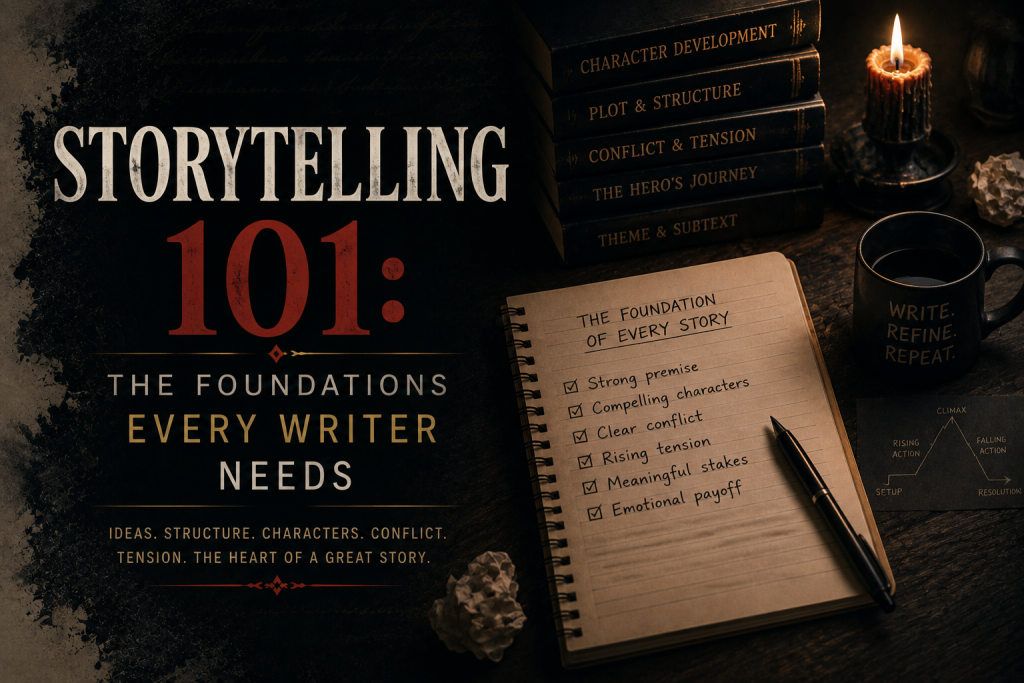
I’m not one to judge people who genuinely want to write (or tell) a story… But I do have a problem with people who think they can make a quick buck by telling a story, thinking they know how and not bothering to learn! We see this a lot in AI-generated stories (I’m not calling them books). These people think they can write— but don’t actually pick up the metaphorical pen! They let a computer do it for them (and neither of them understands what makes a story), so it ends up being garbage and “slop”. So, in this post, I’m going to go over what I feel makes a story… though I do encourage everyone to tell me your thoughts on it as well!
Back in the old days: stories were meant to have morals, a point, or a lesson— the goal was to teach in either an entertaining (but mostly grim) way if you really look at those old tales. You— or the average reader— might be amiss to think this is no longer the case… but it’s only more subtle than it used to be. For instance, “From Below” by Darcy Coates may seem like just an underwater adventure in a ship with possible supernatural danger. Something to itch that craving for suspense! However, it’s a prime example of how dangerous the human mind is in unfamiliar locations and situations— anxiety and our need to fill empty spaces can be more dangerous & lethal than any fish or ghost! It’s subtle, but that is the moral of half the story (since it’s written as a dual-period perspective). So, subtle as they may be: all stories today mean and say something important, and that is the core of what makes a story!
My book, “Agony” (the one currently being re-edited for a re-release), is a supernatural horror that follows a group of friends trapped in a ghost town. They’re being hunted by a monster. Simple premise packed with gore, blood, and body horror— but the heart of the book (and the story as a whole) is about Claire’s desperate chase to save herself from herself. She wants to end her own life. Our tale is about fighting against the monster within, more so than the monster chasing her! It’s about hope and asking for help. This moral undertone is what turns this from what could be just another horror novel into something that (I hope) is helpful and meaningful for others.
Next, I’d like to go back over what I mentioned in the beginning: stories that TRY, but don’t understand. Take this, for example… Someone who wants to write about female empowerment, always fun, and tries to craft a story of a woman who has potential to be a hero— but something is holding her back. The journey is about overcoming that personal flaw (or trauma, or danger, etc.) until she finally becomes her true self and evolves into the hero she wants to be. Sounds good so far, right? The execution, however, let’s say misses the mark and instead: the only real problem is her lack of belief in herself. Now, on the surface, that’s okay! It happens to everyone! Almost every writer I know (or have heard of) is guilty of that, at some point (or multiple times) in their life. However, the issue begins when that little hiccup is the ONLY problem! If this character can overcome every challenge the author throws at them but still doubts themself regardless, then there’s no resolution— because there’s no real conflict. It has the elements of a story, but that’s it.
This problem can (of course) be solved with a beta reader and an editor; never skimp on the professionals because no matter what, you can fail. Don’t let that be the death of your own book!