When I first started writing seriously, I believed there was some magical formula to draft a book — one true system that separated the writers who knew what they were doing from the ones who were just guessing. The “correct” way. I was wrong, and untangling that belief took longer than I’d like to admit!
There’s No Single “Correct” Way to Draft
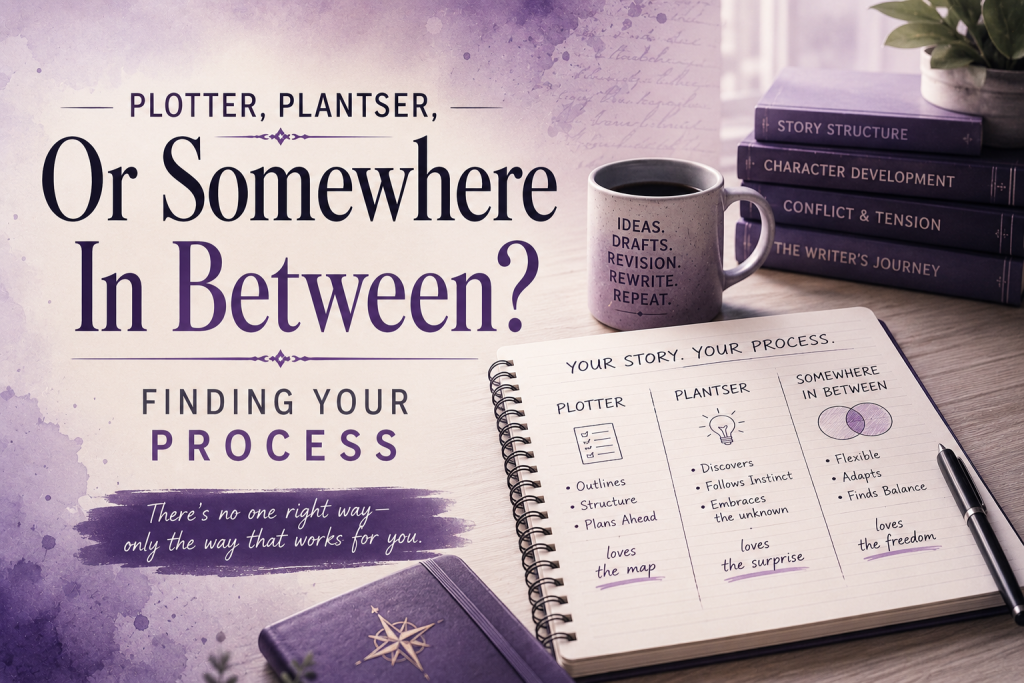
You’ve probably know about the two “camps” already: plotters (those who map the whole story out before writing a single scene) and pantsers (those who start with an idea and let the story reveal itself organically). Writing advice tends to present these as a binary. It feels like the community is screaming at you, “Pick one, commit, and that’s your identity as a writer now!”.
I spent a long time trying to force myself into the plotter camp because it felt like the “responsible” choice. Detailed outlines, chapter breakdowns, character arcs mapped in advance— it seemed like the version of writing that “serious” authors did. You hear about all the extensive mapping that The Greats do, right? But what I actually produced were outlines I abandoned by chapter four, because the story kept wanting to go somewhere the outline hadn’t accounted for.
The truth (which I eventually landed on, lol) is a lot less tidy than either camp wants to admit: there isn’t a correct process. The right way is the one that actually gets your book written! What works for another writer— even one you admire or emulate— was built for their brain, their story, their relationship with uncertainty. It was never a blueprint for yours!
The Hybrid “Plantser” Approach
This was one of those lessons I only learned by doing it wrong first… Seems to be happening to me a lot lately, huh? Oh well… what can I say, it’s all just growing pains 🤣
Somewhere between the two camps is where I actually live, and where a lot of writers end up once they stop trying to force a label: the “plantser” approach. It’s less of a method, more of a compromise… I need just enough of a skeleton to keep me oriented, but enough open space to let the story surprise me.
I’ve talked about this before, but for me: that looks like knowing a small handful of fixed points before I start (i.e how the story opens, one or two major turns I’m writing toward, and how it ends emotionally) even if I don’t yet know exactly how it gets there. It allows my characters, my plot lines, time to breathe… and I enjoy sculpting their stories as I watch them play out on paper. But everything between those points stays undiscovered until I’m actually in the scene… I need just enough structure to keep from feeling lost, and just enough unknown to keep the writing feeling alive instead of like transcription!
It’s not a lack of commitment. It’s a different kind of commitment— one to the story’s process, instead of a predetermined shape I arbitrarily assigned it based off of an incomplete vision in my head.
How to Tell If Your Process Is Actually Working, And Not Just Familiar
Here’s the part that actually matters, and the part most craft advice skips: familiarity and effectiveness are not the same thing. Just because a process feels comfortable doesn’t mean it’s the one getting your book finished.
A few honest questions I ask myself now when I’m not sure if my process is working or just habitual:
- Am I finishing drafts, or am I finishing outlines? If the planning stage is where all your energy goes and the actual manuscript stalls out: the process might be serving your anxiety more than your book.
- Is the “stuck” feeling boredom, or is it fear? Boredom with an overly rigid outline is a signal to loosen up… Fear of the blank page with no plan at all is a signal you might need more structure than you’re giving yourself credit for.
- Are you revising the same three chapters over and over instead of moving forward? That’s often a process mismatch, not a talent problem.
- Would you recommend your current process to a friend, or are you just used to it? Those are different things, and the gap between them is worth paying attention to.
- Does the process change per project, or are you forcing every story into the same shape regardless of what it needs? Some books want a map. Some want room to wander. The same writer can need both at different times.
None of these questions have a universal “right” answer… They’re just a gauge for checking whether your process is actually working for the book in front of you, or whether it’s just the version of writing you’ve always done without asking if it’s serving you.
A Few Free Resources, If You Want to Experiment
If you’re in the middle of figuring out where you land on this spectrum, here are a few free tools and reads that are worth a look (I am NOT SPONSORED… I just don’t believe in gatekeeping):
- Reedsy Studio’s book outline templates — free, genre-specific outlining starter kits if you want to test-drive a more structured approach without committing to it long-term.
- Reedsy’s guide to the Snowflake Method — a step-by-step plotting technique that builds a story gradually from a single sentence, useful if full outlines feel overwhelming but total pantsing feels too loose.
- Pantser, Plotter, Plantser: What Is Your Writing Style? — a free, open-access chapter that breaks down all three approaches clearly if you want a more academic take before deciding where you fall.
None of these will tell you the “right” answer. That part’s still on you. But they’re useful for testing the edges of your own process without a financial commitment.
Where I’ve Landed, For Now
I don’t think I’ll ever be a full plotter, and I’ve stopped feeling like that’s a failure. My process has shifted with every project, and I expect it to keep shifting. The goal was never to find the process. It was to find the one that gets this particular story out of my head intact.
If I could go back and tell my earlier self one thing, it would be this: the process isn’t the achievement. The finished book is. Whatever gets you there honestly is the right one.
And if you’re still in the middle of figuring out your own, you’re exactly where you’re supposed to be!