
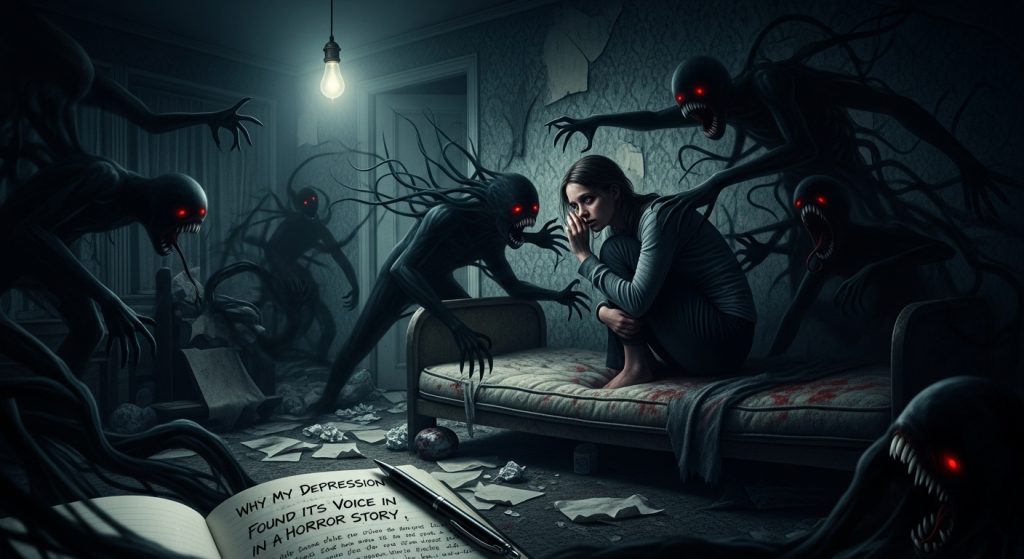
I’ve always been drawn to horror. As a kid growing up in Hawaii, surrounded by obake ghost stories and the raw power of the islands, the supernatural felt… present. But it wasn’t until I started writing my own novel, Agony, that I truly understood why. I realized that horror isn’t just about monsters under the bed. For me, it’s the only genre that truly captures what it feels like to live with depression.
The Shapeshifter Inside
See, depression isn’t a single, simple feeling. It’s a shapeshifter. Some days, it’s just a heavy fog—the world goes gray, and every single task, from getting out of bed to making a meal, feels like you’re wading through mud. Other days, it’s sharper, more malicious. It’s a voice in your ear, a creature with claws, whispering that you’re not good enough, that you’re a burden. How do you show someone what that’s like?
You build a town for it.
Claire’s Mind, Made of Wood and Stone
That’s what the abandoned ghost town in Agony is. It’s not just a spooky setting. It’s Claire’s mind, made real. The crumbling buildings? That’s her self-esteem. The sudden, terrifying collapses of the landscape? Those are her anxiety attacks. And the monsters that hunt her? They’re the physical forms of her trauma, her betrayal, her deepest fears. I didn’t just make this up; it’s how my own brain sometimes feels.
Finding Refuge in the Fog
People often cite Silent Hill as a scary game, but for me, it was a revelation. That foggy, decaying town wasn’t a place of pure terror; it was a place where the internal pain was finally, visibly, on the outside. The fight became clear. In real life, the battle with depression is invisible, a silent war fought behind a smile. But in a horror story, I can make the fight literal. I can make readers feel the exhaustion of running, the panic of being cornered, and the sheer courage it takes to stand your ground against a creature that represents your own self-loathing.
Giving the Pain a Shape
Writing Agony wasn’t about making depression seem cool or edgy. It was about giving it a shape and a sound, so I could point to it and say, “This. This is what it’s like.” My hope is that for readers who haven’t experienced it, the book provides a window into that reality. And for those who have, I hope it’s a validation—a recognition that they aren’t crazy, and they aren’t alone. The real monster isn’t the one with the claws; it’s the isolation. And the victory isn’t about slaying the beast forever, but about learning you don’t have to face it by yourself.