
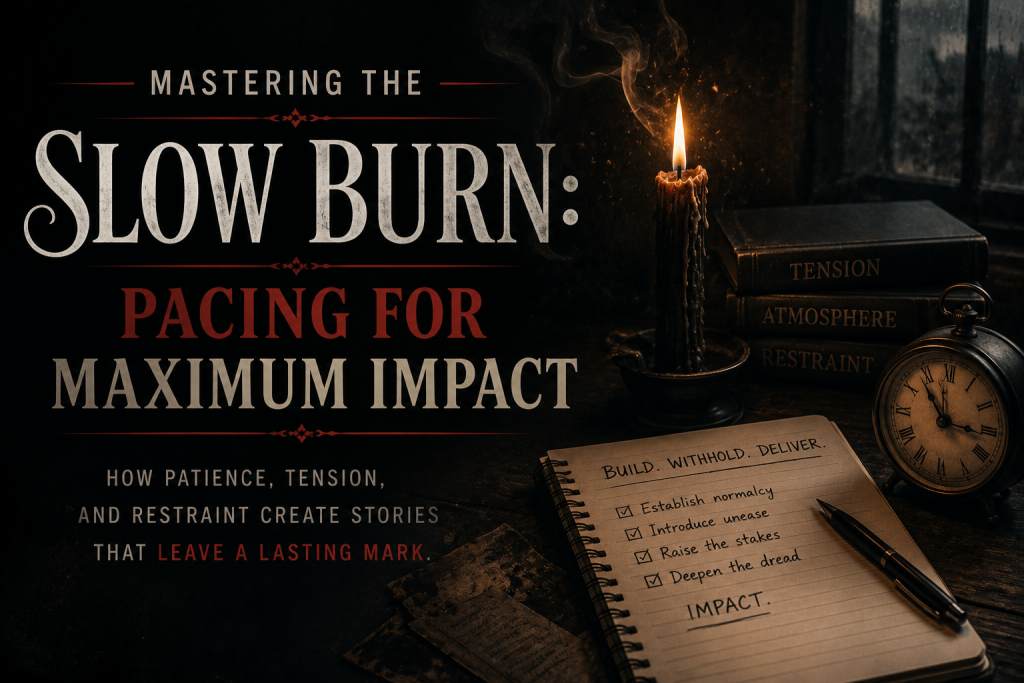
When I first started writing horror, I believed tension = momentum. I thought that if I wasn’t building toward the next scare, I was wasting the reader’s time. I was wrong, and the slow burn is the thing that finally taught me why!
Why Breathing Room Isn’t Wasted Space
I admit, this took an embarrassingly long time to understand: a scene with nothing “happening” in it isn’t a dead scene. Sometimes it’s the most important one in the book!
Breathing room is the quiet stretch between one unsettling moment and the next… It’s the ordinary dinner conversation, the walk home, the mundane errand— and it does more work than it looks like it’s doing. It gives the reader’s nervous system a chance to reset just enough so the next hit actually lands. Horror without any breathing room stops being horror, and turns into just plain old noise. The death of a good story! The reader goes numb. Nothing surprises them, because nothing was ever allowed to feel normal in the first place. See?
This was one of those lessons I only learned by doing it wrong first. Early drafts of “Agony” had scenes stacked on top of scenes, tension piled on tension, and early access readers told me the same thing in different words: it was exhausting, not scary. I had to learn that dread needs contrast to register… You can’t feel the temperature drop if the room was never warm!
How to Build Tension Incrementally
Once I understood breathing room, the next problem was figuring out how to actually escalate *out* of it… How to take a calm scene and slowly tighten the screws, without the reader noticing exactly when it happened!
A few things that changed how I approach this:
- Withhold before you reveal. Give the reader a fragment of information, not the whole picture. Let them sit with the incomplete version longer than feels comfortable.
- Let small details go slightly wrong before anything goes wrong. A door that’s usually locked. A neighbor who doesn’t wave back. Wrongness in miniature reads as more unsettling than wrongness announced!
- Slow the sentence rhythm as tension rises. Shorter, more deliberate sentences near a turn in the scene can do as much work as the content of the scene itself.
- Delay the payoff past the point you think is safe (especially if you’ve never written before!). My instinct is almost always to reveal a beat too early. Pushing it further than feels comfortable is usually the right call.
- Anchor tension in something the character (and by extension, the reader) actually cares about. Dread attached to a relationship or a fear the reader already understands lands harder than dread attached to a stranger or an abstract threat.
None of this is about withholding for its own sake. It’s about making sure that when something finally happens, it has weight— because the reader spent real time not knowing. You don’t have to look far to see this technique working! Here are a few reading recommendations that I think about often when I’m pacing my own scenes:
- Shirley Jackson’s “The Haunting of Hill House” rarely relies on anything overtly supernatural in its early chapters— the dread comes from atmosphere and character unease, masterfully set to brew long before anything happens. Netflix’s adaptation of the same story stretches its reveals across an entire season, letting grief and family tension build the horror as much as the house itself does!
- Ari Aster’s “Hereditary” is patient almost to a fault in its first act, and that patience is exactly why the midpoint lands as hard as it does.
- Henry James’s “The Turn of the Screw” builds its entire sense of dread through ambiguity and restraint rather than incident (which made it arguably one of the earliest and most influential slow burns in the genre!)
What all of these share isn’t a lack of events. It’s a willingness to trust the reader to sit in uncertainty far longer than most stories are comfortable asking of them.
Where I Still Get This Wrong
I’d love to say I’ve mastered this. I haven’t. My first instinct is still to rush— to get to the part I’m excited to write instead of trusting the slow lead-up. What’s changed is that I notice it now, and I’ve learned to go back and add the quiet back in during revision rather than trying to force it in on the first pass.
If I could go back and tell my earlier self one thing, it would be this: the silence before the scare is doing just as much work as the scare itself. Don’t rush past it to get to the part you think is the point.
And if you’re still figuring out where your own pacing needs more room to breathe, that’s okay. We’re all on this learning curve together! Don’t get discouraged, and reach out to the online writing communities for help 😁