
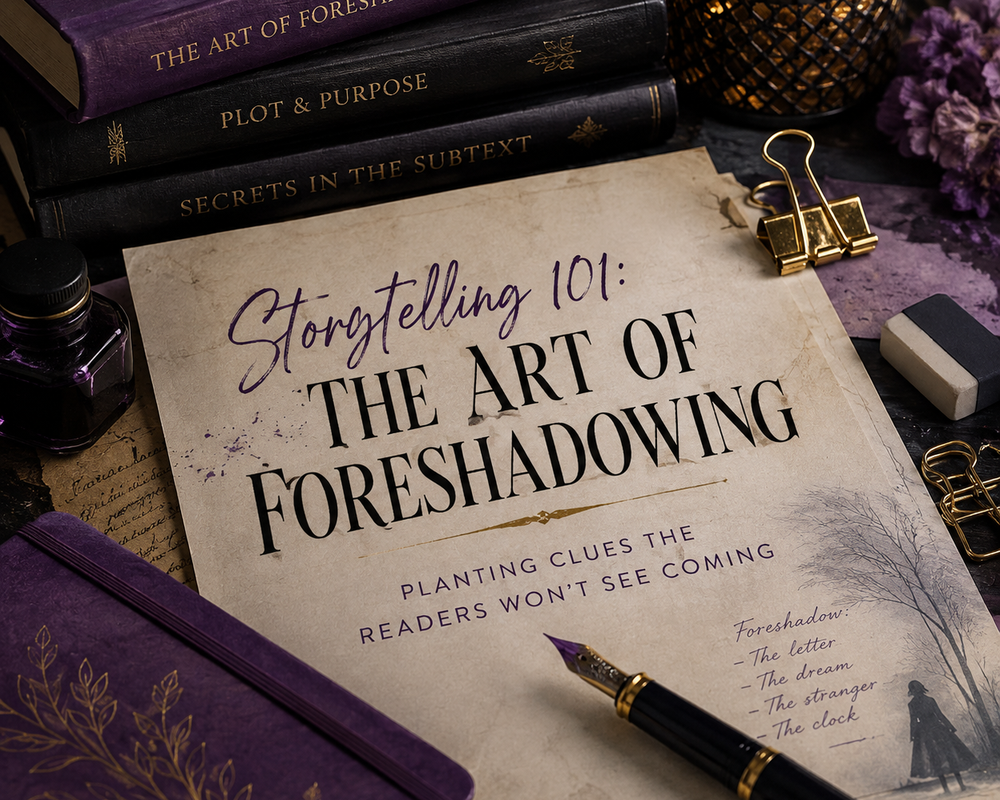
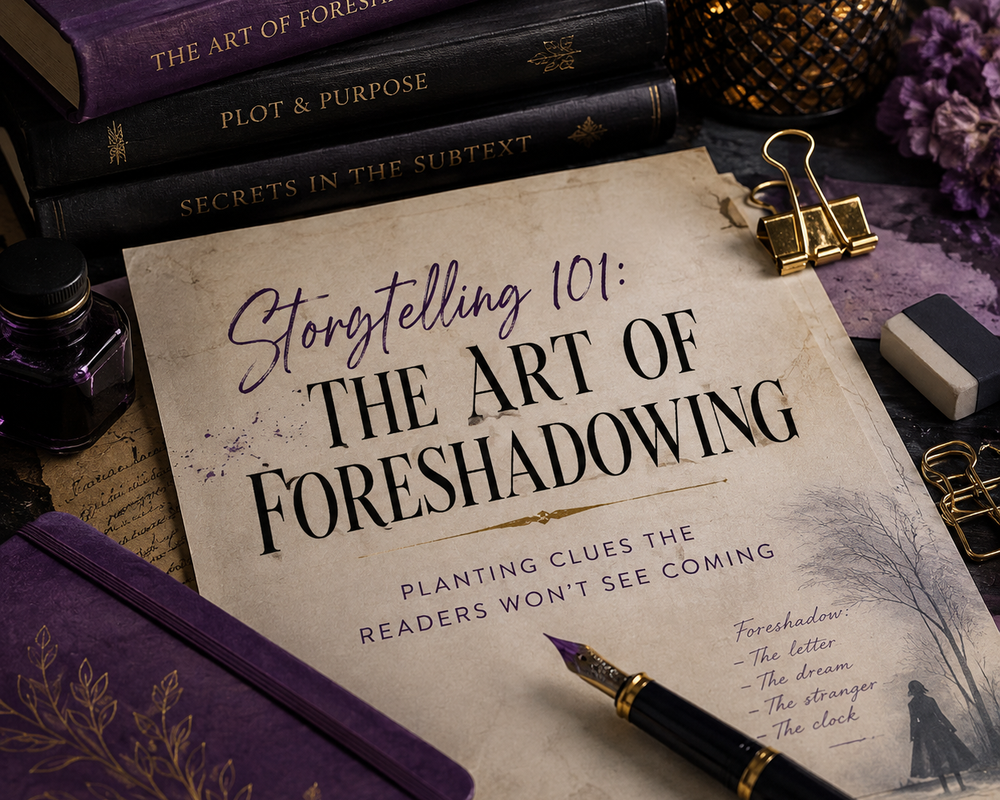
When I first started writing horror, I believed foreshadowing meant making sure the reader understood what was coming: dropping a hint, then circling back to explain it just in case they’d missed it. It took an early beta reader flat-out telling me “I saw that coming from a mile away” for me to realize why!
Foreshadowing Isn’t the Same as Telegraphing
Here’s the distinction I wish someone had handed me on day one: foreshadowing plants a feeling. Telegraphing plants an answer. The first trusts the reader; the second doesn’t… and nobody wants to feel like they’re “too dumb” to figure it out themselves, right?
When you telegraph a twist, you’re usually doing it out of fear… Fear that the reader won’t connect the dots, so you connect them for you. A character says something a little too on-the-nose; a detail gets described with just a little too much weight. The reader doesn’t get to feel the wrongness settle in; they get handed a flashing sign that says “This matters later!”— and that sign kills the very tension you were trying to build.
Real foreshadowing is quieter than that. It’s Chekhov’s old rule about the gun on the wall — if it’s there in Act One, it needs to go off eventually… But the audience shouldn’t know when (or even that they’re being warned at all). In Agony, some of the clues I’m proudest of are the ones that read as completely ordinary the first time through. A throwaway line. A small habit a character has. Nothing underlined, nothing bolded. Just… there, waiting.
This was one of those lessons I only learned by doing it wrong first.
Planting the Clue Is Only Half the Job
The other mistake I made constantly in early drafts: I’d plant a clue and forget I’d planted it. Foreshadowing isn’t just about the setup. It’s a promise, and promises need to be paid off or you’ll leave the reader feeling cheated instead of rewarded.
A few things that changed how I handle this in revision, from my editor:
- Track your plants in a separate document. I keep a running list of every detail I’ve seeded that needs a payoff later. It sounds unglamorous, but I’ve cut entire subplots because I realized (only after I got three drafts in, of course) that I’d made a promise I didn’t keep despite my best intentions at the time!
- Give the payoff more weight than the plant. The clue should be small. The moment it clicks into place shouldn’t be. If your reveal feels smaller than the setup, you’ve built the scene backwards.
- Let some plants pay off structurally, not just literally. Sometimes the payoff isn’t a line of dialogue getting explained: it’s a feeling returning. A location revisited. A phrase that meant nothing the first time and means everything the second.
- Don’t be afraid to cut a plant that isn’t earning its place. Not every early detail needs to become load-bearing. Some are just texture, and that’s allowed… As long as you’re honest with yourself about which is which!
The goal isn’t to trick the reader. It’s to let them feel smart when they catch it, and satisfied even when they don’t— because either way, the story was always heading exactly where it needed to.
How Repetition and Motif Quietly Connect Separate Stories
This is the part of foreshadowing I didn’t expect to fall in love with: using it not just within a single book, but between them.
I’ve talked about this before, but I want to mention it again here since I think it fits! Agony is part of a planned series right now, and I’ve always known I wanted future stories to exist in the same wider world— and one of the quiet joys of that has been planting motifs that don’t pay off within the book they first appear in at all. Now granted, sometimes they’re just a callout to another story: a recurring image; a phrase a character uses that means nothing yet (but will mean everything to a reader three books from now who happens to remember it!). But in this context: it’s foreshadowing on a much longer timeline, and it only works because it’s built on the same principle as foreshadowing within a single scene. You have to trust the reader to carry the detail with them, even when they don’t know yet that it matters.
Stephen King does this constantly: a balloon, a sewer, a recurring symbol that threads through entirely separate books and slowly reveals itself to be part of something much bigger. You don’t need the connection explained to still feel unsettled the second time an image resurfaces. Your subconscious clocks the repetition before your conscious mind catches up, and that’s exactly the sensation I’m chasing!
If You Want to Go Deeper
Just a friendly reminder: I AM NOT SPONSORED; I JUST DON’T BELIEVE IN GATEKEEPING! So here are a few free resources you can keep coming back to when you’re working through foreshadowing in your own drafts, recommended to me by my editor:
- Reedsy’s guide on foreshadowing is a solid overview of the different types, with examples across genres.
- MasterClass’s breakdown of foreshadowing techniques is quite useful for seeing how dialogue, titles, and setting can each carry a clue differently.
- NowNovel’s 8 laws of foreshadowing is a good gut-check list for revision, especially the reminder that not every event actually needs a warning shot.
If I could go back and tell my earlier self one thing, it would be this: the reader doesn’t need you to point at the clue. They need you to trust that it’s there, and trust that they’ll find it— maybe on the first read, maybe on the second, maybe not until they close the book and something clicks days later. And if you’re still figuring out how to plant your own clues without giving the whole game away, that’s okay! Everyone learns at their own pace on their own time, and there’s absolutely nothing wrong with that.