
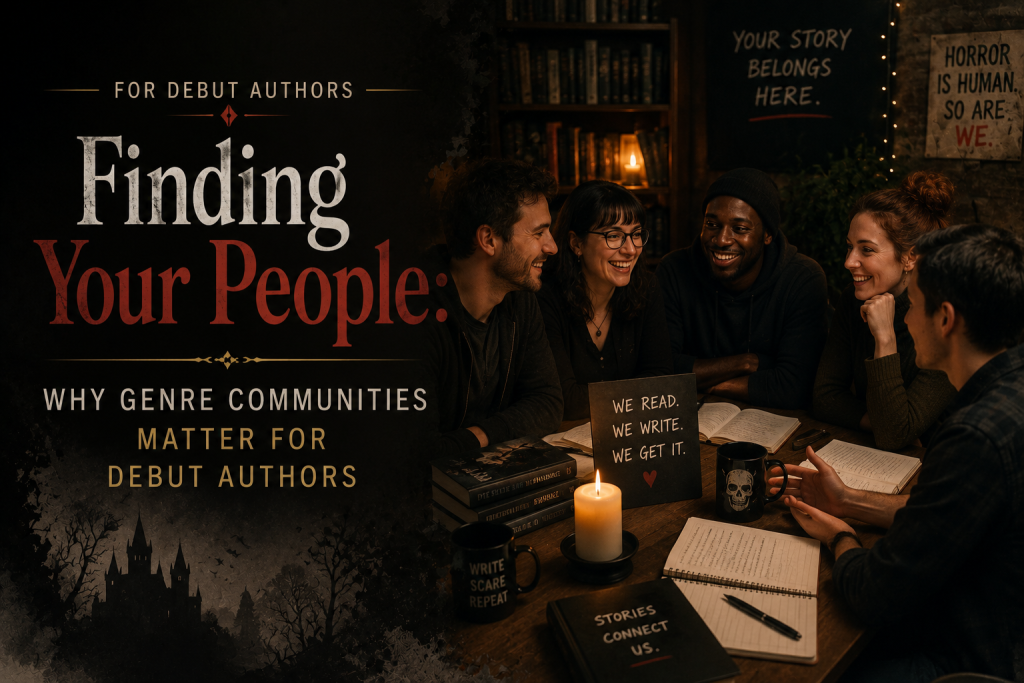
When I first started writing “Agony” (before the rewrite, I mean, haha!), I believed I was building something entirely alone. Just me, a laptop, and whatever hours I could steal from a normal life. I was wrong— and learning why changed how I approach this whole “self-published/ indie author” thing entirely.
The Myth of the Solitary Writer
Nobody warns you about this one… You picture the writer’s life as a closed door: you, the page, and silence. And to be fair, the actual writing usually does happen that way! But somewhere along the line, a lot of us inherit the idea that the *entire* journey is supposed to be a solo act… that needing other people somehow cheapens the work. I believed that for longer than I’d like to admit. I thought asking for help, or wanting to talk to other writers about the parts that scared me, meant I wasn’t cut out for this. Turns out that’s backwards. The writing is solitary. The becoming-a-writer part isn’t supposed to be.
I didn’t expect this genre to be the thing that taught me that lesson.
Horror has a reputation— it’s dark, a little strange, maybe even isolating from the outside looking in. But if you spend any real time around the people who write and read it, and you find something almost contradictory: it might be one of the most welcoming corners of fiction there is.
I think it’s because horror asks something honest of the people who love it. You can’t write convincingly about fear, grief, dread, or the things that keep people up at night without being willing to sit in the dark a little yourself! And when you find other people willing to sit there with you (comparing notes on the things that scare them, the themes they can’t stop returning to)… It stops feeling like isolation, and starts feeling like company. There’s a strange comfort in it. Reading about nightmares, together, somehow makes the real ones smaller!
That’s what a genre community gives you that a general “writing community” sometimes can’t: people who already understand why you’re drawn to the dark stuff, without needing it explained.
How to Actually Start Finding Your People
I really wasn’t prepared for how many hands actually touch a book before it reaches a reader!
I used to picture publishing as this straight line: writer finishes manuscript, manuscript becomes book, book is bought by readers. What I didn’t understand was how much of that middle stretch depends on other people. Editors who see the shape of the story you’re too close to notice… Beta readers willing to tell you the truth about a chapter that isn’t working yet… Cover artists translating a feeling you’ve barely put into words. None of that happens in isolation, and none of it happens without a community you’ve taken the time to build!
The writing might start alone. The book never finishes that way. If you’re earlier in this than I am, here’s what actually helped me (not that I claim to be an expert. Just helping out those who are like me… a little lost in the ink and red tape, haha!):
- Go where the genre already lives online. Horror-specific writing forums, subreddits, and Facebook groups tend to be more active and more generous than general “all genres welcome” spaces. Specificity breeds honesty.
- Trade beta reads before you think you’re ready. Some of the most useful relationships I built started as simple swaps — I’ll read yours if you read mine.
- Follow the hashtags and corners of Bookstagram and BookTok built around your genre, not just your book. Show up as a reader before you show up as an author.
- Look for local or virtual writing groups, even loosely organized ones. You don’t need a formal critique group with rules and deadlines. You need a handful of people who’ll tell you the truth!
- Say yes to the small interactions. A comment left on someone else’s post, a genuine reply to a reader’s message— Community gets built in the small moments far more than the big ones.
Why It Ends Up Mattering More Than You’d Think
The unexpected part wasn’t finding writers who understood the craft side. It was realizing how much it means when a reader’s message lands at exactly the right time… Like when someone tells you a scene you wrote made them feel less alone in something they were carrying. That’s the moment the whole “solitary writer” idea falls apart completely. The work only finishes once someone else is holding it!
If I could go back and tell my earlier self one thing, it would be this: the people are not a distraction from the work. They are a (rather large) part of the work! And if you’re still in the middle of figuring out where you belong in all this, you’re exactly where you’re supposed to be. Keep going!