There’s a moment near the end of The Babadook where the monster— that top-hatted, shrieking thing from a children’s book— retreats to the basement. And the mother feeds it. Every day, she goes down into the dark and leaves a bowl of something at the foot of the stairs. It doesn’t destroy her. It lives in her house. She lives with it.
That’s not a “horror” ending. That’s a “grief” ending. And somehow, it’s one of the most terrifying things committed to film! This is the open secret of horror: at its best, it was never really about the monster. It was about what the monster threatens to take, because fear is the inverse of care.
Fear Is Just Love With Nowhere to Go
Ask yourself: what fear do these characters actually tap into? It’s not simply spiders, not just the dark— dig deeper. The most primal fears aren’t about pain or death (in the abstract). They’re about losing a specific person. Watching someone you love become unrecognizable. Being unable to protect what you’ve built.
Stephen King, the genre’s most decorated practitioner, has been remarkably candid about this. “Pet Sematary” (which he reportedly found too disturbing to publish for years) is, at its core, about a father who loves his son so much that he violates the laws of nature. The horror doesn’t come from the reanimated dead. It comes from recognizing that you would do the exact. Same. Thing. You understand him completely. That understanding is where the dread lives.
Fear, at its root, is the shadow cast by attachment. As I recently mentioned in a social media post: “We cannot dread losing what we don’t value”. The more we love something, the more we fear its absence— and horror fiction is ruthless about exploiting that arithmetic. It finds the thing you hold most carefully and asks: “What if..?”, and this exact concept is why horror is so frequently set inside a family home. The haunted house isn’t just a location— it’s a relationship. Something has gone wrong in the place that was supposed to be safe, among the people who were supposed to be permanent. That violation hits differently than any stranger-in-the-dark scenario, because it turns love itself into the source of danger.
The Vulnerability That Makes the Fear Real
Great horror fiction requires something that seems counterintuitive: it has to make you care before it makes you scared. A story that begins with a monster is just action. A story that begins with a person (their small routines, their private tenderness, the particular way they love the people around them) and then introduces the monster… that’s horror!
Shirley Jackson understood this better than almost anyone. “The Haunting of Hill House” opens not with a ghost, but with Eleanor Vance: a woman in her thirties who has spent her life caring for a sick mother; who has never had her own space; who is pathetically, heartbreakingly thrilled to be chosen for something… By the time Hill House begins its work on her, we’re not watching a victim. We’re watching someone we’ve come to recognize. Her dissolution is terrifying precisely because we’ve been let inside her inner life.
This is the emotional contract horror fiction makes with its reader: “I will show you someone worth caring about, and then I will put them in danger.” The writer has to hold up their end of that bargain first. The vulnerability has to be established before the threat arrives. Otherwise, there’s nothing at stake, and the reader is just watching chess pieces move! What separates literary horror from mere shock is this willingness to slow down: to spend time in the ordinary before the extraordinary arrives. For instance, Carmen Maria Machado’s “Her Body and Other Parties” is terrifying not because of its supernatural elements but because of how precisely it maps the interior of a person— her desires, her doubts, the texture of how she moves through the world. When things start going bottom-up, the chaos enters a life we feel we’ve actually inhabited.
Empathy Is the Architecture Under Every Scare
Here’s the strange alchemy: reading horror fiction is an exercise in radical empathy. To be frightened by a story, you have to agree (on some level) to inhabit the character’s position— to feel what they feel, want what they want, dread what they dread. The reader does this willingly, voluntarily stepping into a perspective not their own and letting it matter to them. If that’s true: horror writers, then, are in the business of building emotional architecture before they fill it with shadows. The careful work of establishing character (the habits, the relationships, the texture of a life) is not just set-up. It is the entire point. Every detail that makes a character feel real is a load-bearing beam in the structure of fear. This empathic work is also, quietly, a moral act. Horror that functions as pure brutality and offers no one to care about is just aggression dressed up in narrative clothes. Horror that asks you to feel something for its characters is doing something more demanding: it’s asking you to understand their love and their fear as extensions of the same impulse. It’s asking you to practice empathy under pressure, to stay present with someone else’s experience even when it becomes unbearable.
Paul Tremblay is a contemporary master of this. His novels are frequently described as slow-burns, and that’s accurate— but “slow” is doing a lot of work in that phrase. What he’s actually doing is building intimacy. He makes you know his characters the way you know people in your own life: imperfectly, affectionately, with a growing sense of what they stand to lose. When the horror arrives, it lands with the weight of something that’s happening to someone real.
In that light, the horror writer and the love poet are working the same quarry. Both are asking: “What does it mean to be this attached to the world? To people who can be taken from you? To a self that might not survive what’s coming?” The love poet writes toward that attachment. The horror writer writes from the terror of its loss.
What the Monster Is Always Standing In For
Look at the great horror works through this lens, and they reorganize themselves. “Hereditary” is about how grief deforms family bonds. “The Shining” is about the slow violence of a father’s self-destruction on the people who love him. “Mexican Gothic” is about the insidious ways that those who claim to love you can consume you instead. “Let the Right One In” is, improbably, one of the most tender love stories of the last twenty years!
The monster is almost always standing in for something: loss, illness, failure. The parts of ourselves we’re afraid to look at directly. Horror gives these things a shape so that we can face them on the page in a way we sometimes cannot face them in life. We face them as teeth, as shadow, as a face in the window. And when the story is working, when the writer has done their job, what you feel at the end isn’t just relief that the story is over. It’s grief… Because you cared. Because the horror worked the way it was supposed to: by making you love something first, and then showing you how easily it can be threatened.
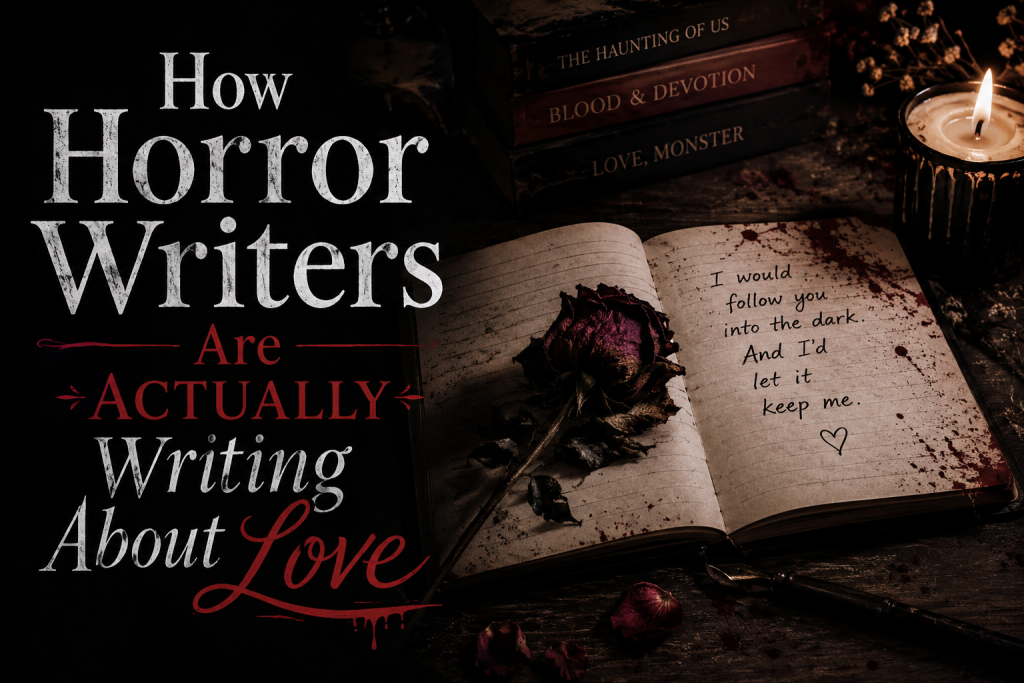
That’s the open secret. The horror writers were writing about love all along. The monsters just helped them say it.